DragonSword Awakening Map Guide Hub – Waypoints, Treasure, Quests & Puzzles
Updated 2026-07-25
Map guide hub: choose what you need
Want a searchable checklist while you play? Open the interactive Orbis map tool to filter sourced locations, inspect community evidence and keep your completed objectives on this device.
DragonSword: Awakening takes place across the Continent of Orbis, an Unreal Engine 5 open world with meadows, fortified settlements, waterways, watchtower cellars, caves, dungeons and deep-sea treasure. The released game also exposes a local HUD minimap and multiple world-progression systems through its public Steam achievements.
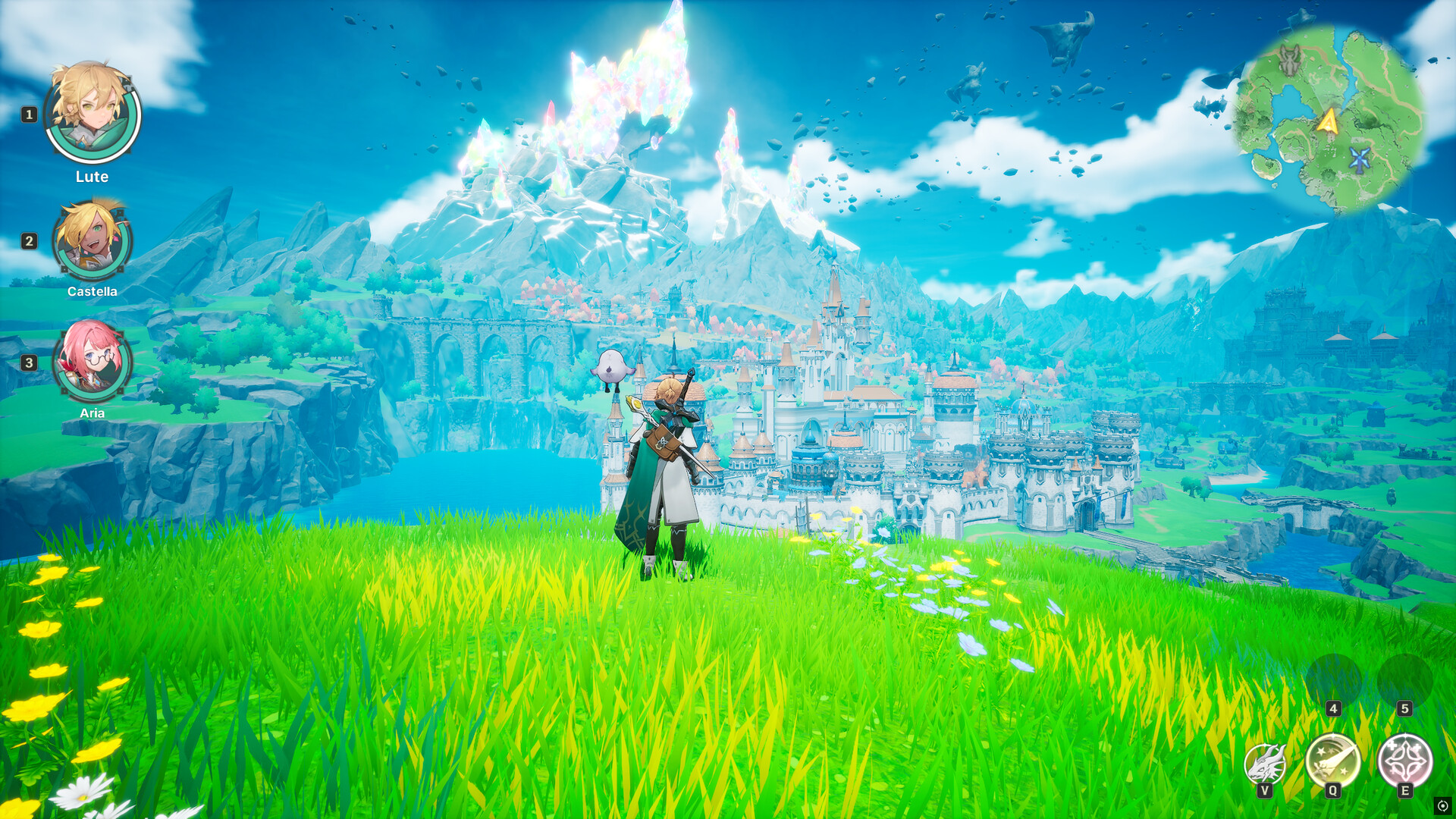
This hub organizes the map-related information by player task instead of pretending that one screenshot is a coordinate-complete interactive map.
| If you are trying to… | Start here | What the guide covers |
|---|---|---|
| unlock travel and reduce backtracking | Waypoints and fast travel | Waypoints, Dungeon Gates, Eona’s Legacy and Goddess Statues |
| find exploration rewards | Treasure and collectibles | Treasure Chests, Treasure Maps, dungeon chests and a safe search routine |
| clear location-based objectives | Quests and puzzles | Area Quests, Sudden Missions, Hero Quests, Bond Quests and confirmed puzzle types |
| cross the suspended Trial of Mist ruins | Trial of Mist Void walkthrough | logging-site orientation, void walkway and platform landmarks |
| finish the mushroom gathering route | Ascension Mushroom quest | waterside passage, ridge search and cooking step |
| understand the first-hours route | Beginner guide | SSD setup, combat basics, progression priorities and when to explore |
| prepare for combat along a route | Combat system guide | Three-hero switching, Status Ailments and Signal Skills |
| check which named heroes have quest evidence | Character roster guide | Current roster boundaries and publicly visible Hero Quest evidence |
| understand gathering and Familiars | Cooking, equipment and Familiars | Officially described gathering and companion systems |
| know where co-op applies | Co-op and raids guide | Supported 2-player and 3-player combat activities |
What the released game confirms about Orbis
The strongest public evidence comes from the live Steam store and the game’s 59 public achievements. Together they confirm that map progression includes:
- Waypoints — the achievement Fast Travel Expert requires activating all Waypoints.
- Eona’s Legacy — The Wind Path That Unveils the Unknown requires activating the full set.
- Goddess Statues of Organa — Oh! Our Goddess requires restoring all statues.
- Dungeon Gates — A Mercenary! Open the Door! confirms gate activation as a progression action.
- Treasure Chests — achievements cover opening a chest, opening more chests and clearing every chest inside a dungeon.
- Treasure Maps — In Search of Hidden Treasure confirms that Treasure Maps are usable.
- Area Quests — achievements exist for completing one and completing the full set.
- Sudden Missions — the game tracks completing ten of them.
- Platform and Slide puzzles — both puzzle types have named achievements.
- Hero Quests — public achievements name quests for Cerese, Dana, Ornette, Theresia and Kalien.
- Subjugations and Raids — these are location-based combat activities, but they belong to the game’s selected co-op boundary rather than free-roam shared exploration.
Recommended exploration loop
Use this loop whenever you enter a new part of Orbis:
- Follow the active story or Area Quest until the local route opens. Do not force unexplained terrain skips.
- Activate the nearest Waypoint. This gives you a return point before you spend time on detours.
- Look for world-progression objects. Eona’s Legacy, Goddess Statues and Dungeon Gates have completion evidence and should not be treated as decorative scenery.
- Sweep side spaces before leaving. The store explicitly mentions watchtower cellars, caves and dungeons, while achievements reward chest exploration.
- Use Treasure Maps when obtained. A dedicated achievement confirms they are an intended exploration action.
- Finish nearby Area Quests and Sudden Missions. They are tied to the world rather than a separate abstract menu-only system.
- Prepare before dungeon or boss routes. Review the combat system, then use the co-op guide if the activity supports a party.
Landmark-based navigation
The available official screenshot is useful as an orientation example, not a coordinate map. It shows:
- a grassy overlook;
- a large fortified city below;
- waterways, cliffs and elevated structures;
- a luminous crystalline mountain in the distance;
- a circular local minimap in the HUD.
When sharing or following a route, use stable landmarks such as gates, towers, bridges, water, cliffs, dungeon entrances and skyline features. A route described only as “go north for a while” is harder to reproduce than one anchored to visible structures and quest text.
Fast travel and world-completion priorities
For efficient map completion, prioritize systems in this order:
| Priority | Map action | Why it matters |
|---|---|---|
| 1 | activate Waypoints | reduces repeated travel and creates safe return points |
| 2 | open Dungeon Gates | supports progression into dungeon content |
| 3 | activate Eona’s Legacy | tracked as a complete world set |
| 4 | restore Goddess Statues | tracked as a complete world set |
| 5 | complete Area Quests | the game tracks both first completion and all completions |
| 6 | clear dungeon chests | one achievement specifically requires every chest in a dungeon |
| 7 | solve puzzles and use Treasure Maps | easy to miss if you only follow the main objective marker |
The dedicated Waypoints and fast travel guide explains how to turn this into a repeatable route checklist.
Treasure, caves and dungeon side paths
The Steam store describes secret cellars beneath watchtowers, treasure-filled deep seas, hidden caves and dungeons. Public achievements separately confirm ordinary chests, more extensive chest hunting, Treasure Maps and dungeon-completion chest checks.
That supports a practical search pattern:
- scan below watchtowers instead of checking only the top;
- inspect paths that descend toward water, caves or lower floors;
- clear dungeon side rooms before the exit or boss transition;
- compare a “suspicious chest” or Treasure Map objective with the current quest text rather than trusting an unlabeled screenshot;
- avoid assuming that one player’s image proves a complete chest count for every version.
Use the focused Treasure and collectibles guide for the full checklist.
Quests and puzzle activity
Map progression is not limited to icons and chests. The achievement list establishes several objective types:
- Area Quests;
- Sudden Missions;
- named character Hero Quests;
- other local character quests;
- Platform Puzzle mini-games;
- Slide Puzzles;
- a marmot betting activity.
If an objective appears to be blocked, first confirm whether it belongs to a story step, local quest, Hero Quest or puzzle interaction. The Quests and puzzles guide separates these activity types and links onward to the character guide.
Current focused route pages cover the Trial of Mist Void and Ascension Mushroom quest. Both keep thumbnail-derived locations and sampled video frames separate from unverified exact coordinates or rewards.
Map and co-op boundary
Steam lists Single-player and Online Co-op, while official developer material limits co-op to selected combat activities:
- Subjugation: up to 2 players.
- Raid: up to 3 players.
This hub does not claim that the entire Orbis overworld can be explored as a shared co-op map. For multiplayer routes, start with the co-op and raids guide, then return here for solo-world navigation and objective planning.
Current map-data boundary
This site does not yet publish exact coordinates for every Waypoint, statue, chest or dungeon entrance. The current public sources do not provide a reproducible coordinate-complete world dataset.
What can safely be published now:
- named map systems and objective types;
- achievement-backed completion targets;
- official landscape and exploration descriptions;
- route-planning methods based on landmarks, quests and progression objects;
- dated links to current community-created guides.
What still requires a dedicated release-build survey:
- every region and subregion name;
- exact coordinates for all Waypoints and statues;
- per-zone chest totals;
- every dungeon entrance and floor route;
- a verified full-world image or interactive overlay.
Current community map resources
Steam’s Community Guides page includes filters for Maps or Levels, Walkthroughs, Secrets, Loot, Gameplay Basics, Co-op and Achievements. Those categories are useful discovery points, but the existence of a filter does not prove that a guide is complete or current.
When evaluating a community route:
- check its publication/update date;
- match landmarks and objective text to your current game;
- separate screenshots from verified coordinates;
- check whether the route assumes a particular quest state;
- use the current patch version when reporting a mismatch.
Sources
- DragonSword: Awakening Steam Store Page – official world and exploration description.
- DragonSword: Awakening Global Achievements – public evidence for Waypoints, Eona’s Legacy, Goddess Statues, Dungeon Gates, Treasure Maps, chests, quests and puzzles.
- Steam Community Guides – current player-guide categories and community resources.
- Now Live announcement – confirms the released Steam build is available.
Related Guides
DragonSword Awakening Talk to Ornette Quest Blocked: Official Fix Status
Update 1.0.5 fixed the Talk to Ornette progression blocker in Adventure Quests 15, 16, 17 and 18. Check the affected quests and safe next steps.
DragonSword Awakening Quest Progression Fixes in Update 1.0.4
Check the official 1.0.4 fix status for Siege, Where the Giant Sleeps, Dana’s Hero Quest, Steelheart Fortress, Weldon and other blocked quests.
DragonSword Awakening Update 1.0.4: Player-Facing Changes
A practical guide to DragonSword: Awakening patch 1.0.4 covering combat fixes, rewards, quest blockers, controls, graphics and multiplayer changes.
DragonSword Awakening World Boss Rewards After Update 1.0.4
Compare the official Mercenary Corps EXP and fixed item rewards for all nine DragonSword: Awakening World Bosses changed in update 1.0.4.